Stainless Steel Round Bars: Grades, Properties & Uses
Stainless steel round bars rank among the most dependable engineering materials across manufacturing, marine, construction, food processing, and chemical industries. Their strength-to-weight ratio, corrosion resistance, and ease of machining make them the default choice for engineers who cannot afford material failure mid-service. From pump shafts to structural fasteners, these bars carry real load in real environments, and the grade you select determines how long they last.
A reliable Stainless steel round bar manufacturer provides various grades and sizes which are perfect for industrial and commercial applications that require durability and corrosion resistance. These bars are supplied in solid cylindrical cross-sections and cut or drawn to exact diameters. They are used wherever a round metallic element must withstand mechanical stress, chemical attack, or high temperature. Stainless Steel Rods is the same term for the same product category, and is often used interchangeably in procurement and fabrication contexts.
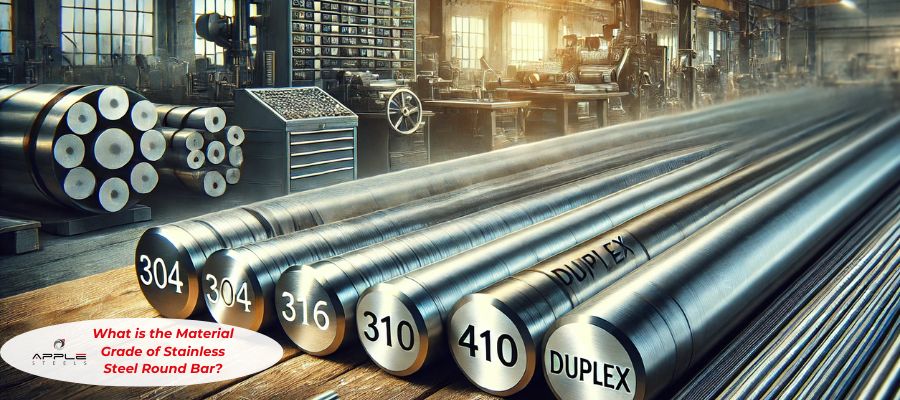
Common Stainless Steel Round Bar Grades
SS 304 Round Bar
SS 304 contains 18–20% chromium and 8–10.5% nickel, which gives it solid atmospheric corrosion resistance without requiring additional alloying elements. It holds up well in environments exposed to moisture, mild acids, and oxidising conditions. Food processing plants rely on it for conveyor components, mixing shafts, and fittings because the surface resists contamination, meets hygiene standards, and tolerates regular cleaning with acidic or alkaline agents.
SS 316 Round Bar
SS 316 adds 2–3% molybdenum to the chromium-nickel base, and that single addition changes its entire performance profile in aggressive environments. Chloride ions, which cause pitting in SS 304, do far less damage to SS 316. Marine fabricators use it for propeller shafts, deck fittings, and fasteners that stay submerged or exposed to salt spray for years. Chemical processing plants also favour it for reactor internals and pump components that handle sulphuric acid, phosphoric acid, and chloride-bearing process streams.
SS 410 Round Bar
SS 410 belongs to the martensitic family, with 11.5–13.5% chromium and minimal nickel. Heat treatment can push its hardness to 35–45 HRC, making it the right grade when wear resistance matters more than chemical resistance. Valve stems, pump sleeves, turbine blades, and cutting tools built from SS 410 round bars hold their edge and geometry far longer than austenitic grades under abrasive or high-contact-pressure service conditions.
Duplex Stainless Steel Round Bars
Duplex grades, such as 2205, combine an austenitic and ferritic microstructure in roughly equal proportions. This bi-phase structure has a tensile strength of about 620 MPa, almost twice that of SS 304, but is still resistant to chloride stress corrosion cracking. Duplex stainless steel round bars are widely used in offshore oil and gas platforms, desalination plants and subsea pipelines. Duplex stainless steel round bars are capable of withstanding seawater, high pressure and cyclic loading at the same time without premature failure.
Chemical Composition of Stainless Steel Round Bars
Each grade achieves its performance through a distinct balance of alloying elements.
| Grade | Chromium | Nickel | Molybdenum |
| 304 | 18–20% | 8–10.5% | Nil |
| 316 | 16–18% | 10–14% | 2–3% |
| 410 | 11.5–13.5% | Low | Nil |
Chromium drives corrosion resistance by forming a passive oxide layer on the bar surface the moment it contacts oxygen. When chromium content crosses 10.5%, this self-repairing layer forms spontaneously and regenerates after scratching or cutting. Nickel stabilises the austenitic phase and improves toughness and formability at both ambient and sub-zero temperatures. SS 316 is superior to SS 304 in coastal and chemical service due to molybdenum, which improves pitting resistance in chloride environments. Martensitic grades, like SS 410, trade some corrosion resistance for hardness. This compromise is suitable for mechanical wear applications where austenitic grades would deform or gall under load.
Mechanical Properties of Stainless Steel Round Bars
The mechanical requirements of the application are also a factor in the selection of the right grade.
| Grade | Tensile Strength | Yield Strength | Hardness |
| 304 | 515 MPa | 205 MPa | 92 HRB |
| 316 | 485 MPa | 170 MPa | 95 HRB |
| 410 | 485–860 MPa | 275–620 MPa | Up to 45 HRC |
SS 304 and 316 round bars provide reliable ductility and weldability in most thicknesses without need for pre-heat or post-weld heat treatment. Good control of heat treatment is necessary in welding to avoid cracking with SS 410. Both the austenitic grades are free from deformation in the temperature range of -60°C to 400°C. Some grades are suitable for cryogenic service.
Key Properties of Stainless Steel Round Bars
Corrosion resistance: The passive chromium oxide layer forms in milliseconds when the bar surface contacts air or moisture. Depending on the grade chosen, it seals the metal against oxidation, acid attack and chloride pitting.
High tensile strength: SS 304 and SS 316 bars can withstand 485 – 515 MPa tensile loads, while duplex grades can withstand over 620 MPa. This strength is used by structural and pressure-bearing components without requiring extra wall thickness.
Heat resistance: Austenitic grades maintain their mechanical properties at continuously service temperatures up to 870°C, intermittently service up to 925°C. This makes them useful for furnace parts, heat exchangers and exhaust system hardware.
Long service life: A correctly specified stainless steel round bar for its intended environment will routinely last three to five times longer than carbon steel alternatives, minimising the need for replacement and downtime.
Hygienic surface: Smooth, non-porous bar surfaces in SS 304 and SS 316 prevent bacterial adhesion and product contamination. Pharmaceutical and food manufacturing regulations frequently mandate these grades for this exact reason.
Low maintenance: Unlike coated or plated carbon steel, stainless steel round bars need no periodic painting, plating, or rust treatment. The passive layer maintains itself as long as the surface stays clean and oxygen-accessible.
Stainless Steel Round Bar Specifications
Stainless steel round bars cover a diameter range from 3 mm to 500 mm, with standard lengths of 3 metres, 6 metres, and 12 metres. Custom-cut lengths are also available for project-specific requirements. The governing standards are ASTM A276 for cold-finished and hot-finished bars used in general structural and mechanical applications, and ASTM A479 for bars and shapes intended for boiler, pressure vessel, and general structural use. Surface finishes span from hot-rolled mill finish, to turned and polished, to centreless ground with tolerances held to h9 or h11 depending on application precision. Diameter tolerances under ASTM A276 typically fall within +0 / -0.13 mm for bars up to 50 mm in diameter, tightening further for precision-ground product.
Advantages of Stainless Steel Round Bars
Fabricators and project engineers return to stainless steel round bars for reasons that directly affect total project cost and equipment lifetime. The material handles forming, turning, milling, and drilling without exotic tooling. Weldability in austenitic grades removes the need for post-weld annealing in most structural joints, cutting lead times. The recycling rate for stainless steel exceeds 85% globally, and the recovery value at end-of-life offsets part of the original material cost. Over a 15 to 20-year asset life, the absence of corrosion maintenance and coating cycles makes stainless steel round bars less expensive per service hour than lower-grade alternatives, even when the upfront price runs higher.
Conclusion
Choosing the right stainless steel round bar grade determines how the finished component performs over its entire service life. SS 304 covers general-purpose corrosion resistance and food-grade fabrication. SS 316 handles chloride-rich and chemical environments that would pit or stain lesser grades. SS 410 delivers the hardness and wear resistance that austenitic grades cannot match under abrasive load. Duplex grades step in where high strength and seawater corrosion resistance must coexist. Apple Steels supplies all these grades to exact ASTM A276 and ASTM A479 specifications, with the dimensional accuracy and surface quality that industrial and commercial projects demand. Contact Apple Steels to discuss your grade, diameter, and quantity requirements with a team that has supplied the stainless steel market since 1984.