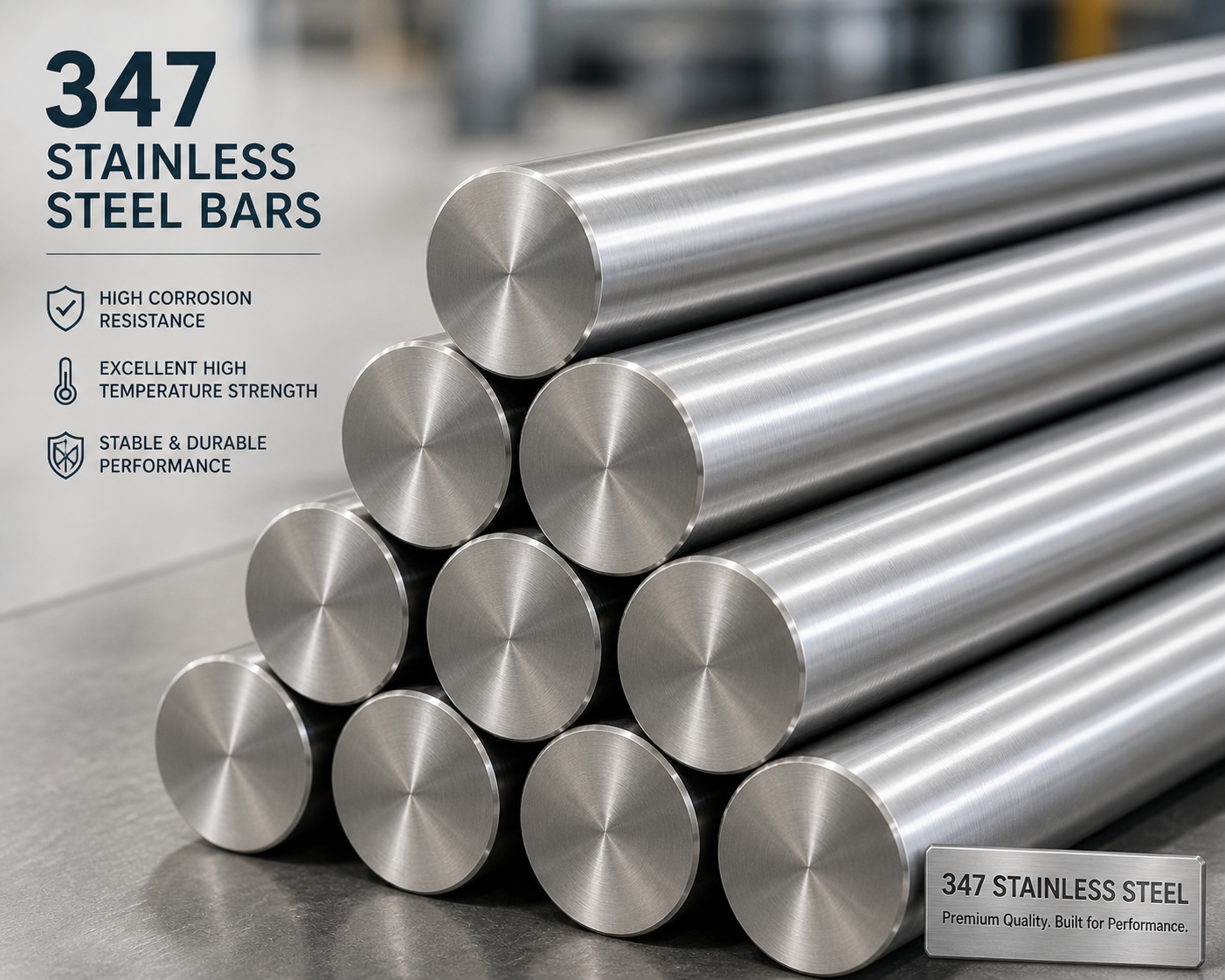
Stainless steel is used across nearly every industrial sector, and picking the right grade matters more than people often assume. Using the wrong one leads to early failure, unplanned downtime, and maintenance costs that add up quickly. The 347 Stainless Steel Bar is a stabilised austenitic grade built for high-temperature and corrosion-heavy applications, where standard grades like 304 or 316 tend to fall short. Leading suppliers of stainless steel and high-nickel-alloy products, provide certified 347 bars to clients across oil and gas, aerospace, power generation, and chemical processing. This guide covers what the material is, where it is used, how to install it correctly, and how to maintain it.
What is a 347 Stainless Steel Bar?
Composition and Properties
- Stabilised with niobium: Niobium is added to prevent carbide precipitation at grain boundaries. This is the main cause of intergranular corrosion in sensitised stainless steel, and 347 is designed to prevent it
- Resistant to intergranular corrosion: Performs reliably after welding and during prolonged high-temperature service, without the sensitisation issues common in unstabilised grades
- High-temperature strength and oxidation resistance: Retains structural integrity at temperatures up to around 870°C, making it suitable for applications where most other grades would weaken over time
Key Features and Benefits
- Excellent weldability: Can be welded without post-weld annealing, which reduces fabrication time and complexity
- Superior creep resistance: Holds its form under sustained mechanical load at elevated temperatures, which matters in pressure-bearing applications
- Long service life: Designed for continuous use in harsh, demanding conditions with less frequent need for repair or replacement
Common Industrial Applications of 347 Stainless Steel Bars
- Heat exchangers: Handles repeated thermal cycling without losing corrosion resistance at tube joints or weld zones
- Pressure vessels: It performs reliably under sustained internal pressure combined with elevated operating temperatures
- Chemical processing equipment: They tolerate exposure to acids, alkalis, and other corrosive process fluids over long periods
- Aerospace components: These bars are used in structural and exhaust-adjacent parts that are subject to constant heat stress and mechanical load
- Power generation industries: It is suitable for boiler components, superheater tubes, and turbine parts that operate in high-temperature steam environments
Why Choose 347 Stainless Steel Bar for Industrial Equipment?
Grade 304 performs well against corrosion in mild conditions, but it is not suitable for high-temperature welded service where sensitisation may occur. Grade 316 adds molybdenum for better chloride resistance, but neither matches 347 in thermal stability. At high operating temperatures, 347 maintains structural strength and resists sensitisation where the other two would require more frequent inspection. In practice, that reduces maintenance frequency and lowers total cost over the equipment’s service life. For continuous-duty applications, the reliability difference is practical and measurable.
Pre-Installation Preparation
Tools and Equipment Required
- Cutting tools: cold saws, circular saws, or angle grinders rated for stainless steel
- Measuring instruments: vernier callipers, steel rulers, and measuring tapes for accurate layout
- Welding equipment: TIG or MIG welding machine with settings appropriate for austenitic stainless steel
Safety Precautions
- Wear full PPE throughout every stage: gloves, safety goggles, and welding helmets as applicable
- Use lifting equipment for heavy bars; lifting them by hand greatly increases the risk of injury.
- Follow all site safety rules and keep the work area clear of extra people and hazards.
Material Inspection
- Verify bar dimensions against the design specification before any work begins
- Check the bar surface for visible defects such as pits, seams, or surface cracks
- Confirm material certification and traceability before accepting the supply. Apple Steels provides full mill test reports with every order
Step-by-Step Installation Process of 347 Stainless Steel Bar
Step 1: Measurement and Planning
Take accurate measurements directly from the equipment’s design drawings. Mark cutting lines and reference points clearly on the bar before picking up any tooling.
Step 2: Cutting and Shaping
Use tools made for stainless steel and cut accurately. Small mistakes now can become bigger alignment problems later.
Step 3: Surface Preparation
Carefully clean every surface to get rid of oil, grease, scale, and any other contaminants before fitting or welding. Then deburr and smooth all cut edges to reduce stress concentration points during use.
Step 4: Welding and Joining
TIG welding is the commonly used method for precision joints. MIG welding is acceptable for larger or less critical sections. Use ER347-compatible filler wire. Keep heat input controlled throughout; overheating can affect the grain structure even in a stabilised grade like 347.
Step 5: Installation and Alignment
Secure bars firmly using clamps or fixtures before final fastening. Verify alignment against design tolerances at this stage, before the assembly is complete and corrections become difficult.
Step 6: Final Inspection and Testing
Carry out a visual inspection of all joints, welds, and fitted sections. Run load and stress tests according to the applicable industrial standard. Document compliance before the equipment is commissioned.
Best Practices for Using 347 Stainless Steel Bars
Keep 347 bars separated from carbon steel in storage, handling, and fabrication. Carbon particles embed in the stainless surface and cause localised rust. Store bars off the ground, covered, and away from chloride-heavy environments. Use sharp tooling and slower feed rates when machining; stainless work-hardens quickly with worn tooling. Build maintenance intervals into the schedule from the start.
Maintenance Tips for Long-Term Performance
Routine Inspection
During every scheduled maintenance, inspect welds, joints, and contact points for wear, tiny cracks, or early signs of rust. Fixing problems early is much reasonable than waiting for something to fail.
Cleaning Methods
Use mild cleaners made for stainless steel. Do not use bleach or chloride cleaners, because they slowly damage the protective surface.
Repair and Replacement
Minor surface corrosion can often be treated through passivation. Structural cracks, severe pitting, or significant cross-section loss require replacement rather than repair. Always use certified 347 bars for replacements. Apple Steels supplies replacement material with full traceability documentation, so there is no uncertainty about grade or quality.
Common Mistakes to Avoid
Applying welding parameters set for 304 or 316 to 347 without adjustment is a common mistake; the grades behave differently under heat and joint quality suffers. Skipping material inspection before installation is another issue. Out-of-tolerance bars cause fitting problems that are difficult to correct once work is underway. Misalignment in multi-bar assemblies distributes load unevenly and shortens service life. Using uncertified or substitute material to save money at the start usually ends up costing more later because of early failures or failed inspections.
Advantages of Sourcing from Apple Steels
Apple Steels supplies certified 347 Stainless Steel Bars with complete material traceability at every order. Stock is consistently available, which matters for industrial projects that run to firm schedules. Their technical team can assist with grade selection, specification queries, and documentation requirements without unnecessary back-and-forth. Pricing is competitive, and the reliability of supply is something clients across sectors like oil and gas, power generation, and aerospace have relied on over time. For organisations that need a supplier they can return to without complications, Apple Steels covers that consistently.
Conclusion
Apple Steels has supported industrial clients across sectors who need certified stainless steel in demanding applications. Installing and maintaining 347 Stainless Steel Bars correctly is not complicated, but each stage needs to be followed properly. Material inspection, controlled welding, accurate alignment, and scheduled maintenance all contribute directly to long service life and fewer unplanned stoppages. The 347 grade suits high-temperature environments well, and sourcing from a verified supplier removes uncertainty from the process.
Need certified 347 Stainless Steel Bars for your next project? Contact Apple Steels today for stock availability, technical support, and pricing.