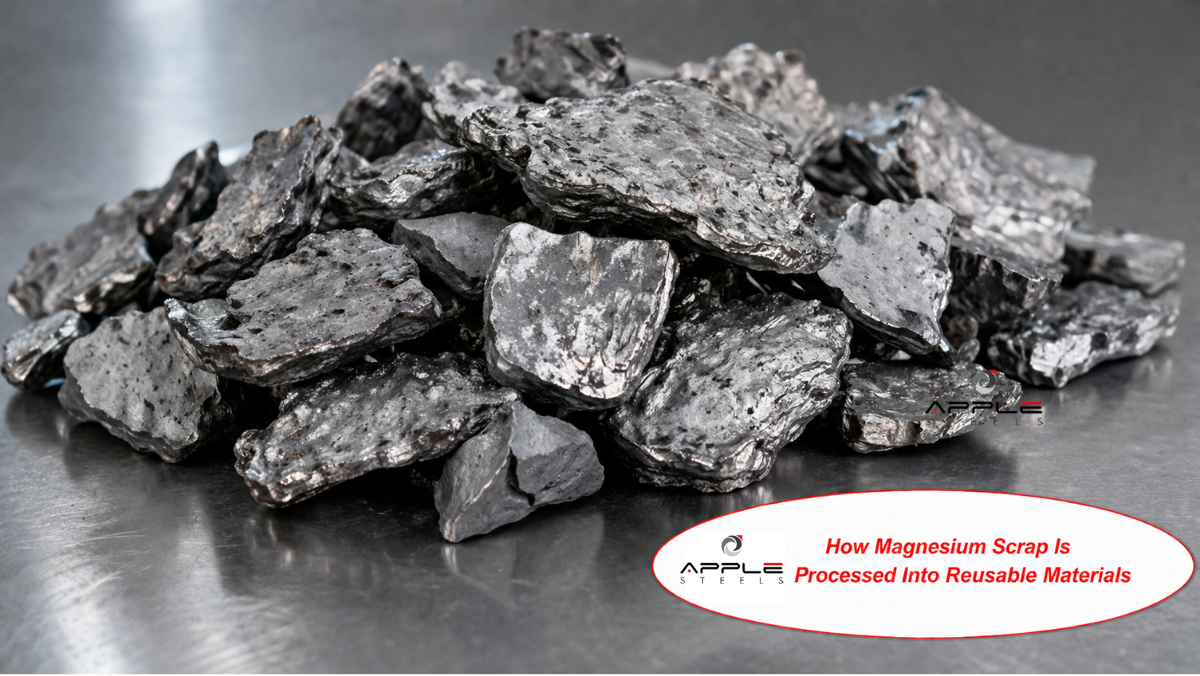
Magnesium is the lightest structural metal in commercial use, and that single property is why so much of it ends up as chips, turnings, and offcuts on factory floors rather than staying locked inside a finished part. Magnesium scrap forms during machining, casting, and fabrication, and it also comes from products that have reached the end of their service life. None of it needs to go to landfill. Almost every form of magnesium scrap can be recovered and recycled, making it a valuable raw material instead of waste.
Recycling is important because it allows materials that have already been extracted and processed to be reused instead of being discarded. Magnesium scrap recovery reduces how much manufacturers depend on primary metal production, and that has consequences beyond one factory or one supply order. Primary magnesium comes from finite ore reserves, and pulling it out of the ground and refining it into usable metal takes a fixed amount of energy, no matter how efficient the plant is. Recovered scrap skips most of that energy cost. Resource conservation, in this context, is not an abstract goal. It is a direct outcome of how much scrap gets collected, sorted, and returned to production instead of being thrown away.
Understanding the Sources of Magnesium Scrap
Most magnesium scrap begins from the factory floor. Machining operations generate chips, turnings, and borings as raw stock gets cut down to final dimensions. Die-casting adds another layer, producing runners, sprues, and rejected parts that never leave the plant. This is process scrap, and it tends to be cleaner because the alloy grade is already known. Post-consumer scrap works differently. It comes from automotive parts, aerospace components, and industrial equipment that have reached the end of service. Both streams feed recycling facilities, though die-casting operations in particular produce scrap volumes large enough to justify dedicated collection and sorting.
Why Magnesium Scrap Recovery Matters
Recovering magnesium instead of mining and refining new ore conserves a raw material that exists in limited, geographically concentrated deposits. The bigger factor is energy. Producing primary magnesium is energy-intensive, involving high-temperature reduction processes that consume far more power than remelting recovered scrap. Secondary production cuts the energy input substantially. Lower energy consumption also means less environmental impact through the supply chain, from extraction to smelting. Closed-loop recycling, in which scrap from one production run is used in the next, increases material efficiency and provides manufacturers with a more predictable and sustainable input stream than virgin metal alone.
How Magnesium Scrap Recycling Works
Recovery begins with collection. Scrap is collected at the point of generation and sorted by type, separating turnings from solid cuts and machining fines from casting rejects. Sorting follows, and it is this step that determines a great deal about the final output. Operators classify material by alloy grade and test for contamination such as oils, coolants, or mixed metals. Clean, well-sorted scrap moves into melting. Two approaches dominate here. Flux melting uses a protective salt layer to limit oxidation during remelting. Fluxless melting relies on controlled atmospheres instead, avoiding the flux residue altogether. Either method, once complete, delivers metal ready for reuse in new products.
Factors That Influence Magnesium Scrap Value
Recovery value is not a fixed thing. It depends on purity of the alloy, contamination, form and market conditions.
- Purity and alloy composition decide most of the price gap between scrap grades. High-purity magnesium free of mixed alloys commands better returns because it needs less processing before reuse.
- Contamination levels pull value down fast. Oil residue, coatings, or mixed metals in a batch force additional cleaning steps, and heavier contamination sometimes limits which end uses the recovered metal can serve.
- The form of scrap material matters too. Solid cuts and plate offcuts process more easily than fine turnings, which oxidise faster and are harder to handle in bulk.
- Market demand and supply set the baseline. Recovery value moves with broader metal markets, and periods of tight primary supply tend to push recycled material prices upward as well.
Industries That Benefit From Magnesium Recycling
Recovered magnesium feeds into several sectors, each drawing on different properties of the metal.
- Magnesium alloys are used in the manufacturing of automotive steering components, transmission cases and structural parts where the low density of the metal reduces vehicle weight without compromising strength.
- Aerospace and aviation rely on magnesium’s strength-to-weight ratio for structural elements and interior components, applications where every kilogram saved has a measurable fuel impact over the life of the aircraft.
- Aluminium alloy production absorbs a significant share of recycled magnesium, since small additions improve strength, stiffness, and corrosion resistance in aluminium-based products.
- Engineering and industrial applications use recovered magnesium in components where weight reduction and mechanical performance both matter, from housings to fixtures.
Challenges Associated With Magnesium Scrap Recycling
Collection sounds simple in theory. In practice, scrap arrives from multiple sources at different purity levels, and keeping streams separated takes discipline on the shop floor. Alloy identification is the harder problem. Magnesium alloys vary in composition, and mixing grades during collection lowers the value of the entire batch. Impurity removal adds cost and time, particularly when scrap carries oil, paint, or bonded materials from its original application. None of these steps can be skipped without affecting output quality. A recycler that classifies alloys correctly and removes contaminants thoroughly ends up with metal that meets specifications. One that cuts corners produces material suited only for lower-grade applications, which defeats part of the purpose of recovering it in the first place.
The Growing Importance of Magnesium Recycling in Modern Manufacturing
Demand for lightweight materials keeps rising across transport and industrial sectors, and that trend is pulling secondary magnesium further into mainstream supply chains.
- Demand for lightweight materials drives design decisions in automotive and aerospace engineering, where reducing structural weight improves fuel efficiency and payload capacity at the same time.
- Circular economy initiatives exert pressure on manufacturers to think about material recovery from the design phase and not to treat scrap as an afterthought when a product reaches the end of life.
- Resource efficiency becomes a practical necessity as primary ore reserves face longer extraction timelines and higher processing costs in certain regions.
- Sustainable metal supply chains depend on a steady mix of primary and secondary material, and secondary magnesium reduces exposure to price swings tied entirely to virgin resource availability.
Conclusion
Recovering and reusing magnesium scrap keeps a valuable material moving through the supply chain instead of ending up as landfill waste. It conserves raw ore, cuts the energy burden tied to primary production, and gives manufacturers a more stable material source to plan around. Understanding what drives magnesium scrap value, from alloy purity to proper sorting, helps buyers and processors get better returns while supporting the resource efficiency that long-term material availability depends on. Apple Steels deals in magnesium scrap and related recovered metals for industrial buyers in India.