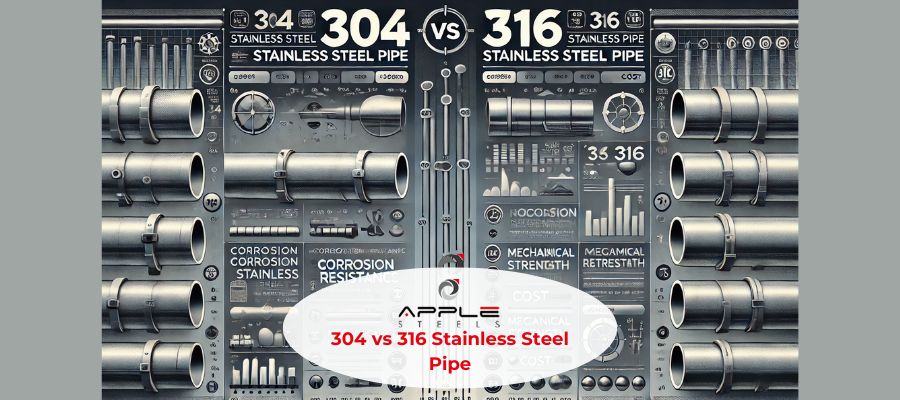
Picking the wrong stainless steel grade does not just cost money on a replacement order. It costs downtime, failed inspections, and corrosion damage in environments that demand better. There is a confusion when it comes to choosing between 304 and 316. Picking the right grade depends on where the pipe goes and what it carries. The below guide provides a clear explanation of which grade is more suitable for your requirements.
What is 304 Stainless Steel Pipe?
304 stainless steel pipe carries 18–20% chromium and 8–10.5% nickel, with no molybdenum. That pairing builds a stable oxide layer on the surface, blocking moisture and oxygen from reaching the base metal. The grade resists mild atmospheric corrosion and most organic acids at moderate temperatures. Because it combines weldability and good corrosion resistance at a lower raw material cost, 304 stainless steel pipe stays the most purchased grade across general industrial and commercial projects. Food processing lines, water distribution networks, architectural cladding, and kitchen equipment all rely on it. Where chloride exposure stays low and chemical contact stays mild, this stainless steel pipe handles the job reliably without overengineering the solution.
What is 316 Stainless Steel Pipe?
316 stainless steel pipe adds 2–3% molybdenum to the chromium-nickel base, and that single addition changes the corrosion resistance profile substantially. Molybdenum stabilises the passive oxide layer against chloride attack, preventing the pitting and crevice corrosion that breaks down 304 in aggressive environments. With 10–14% nickel content, 316 also resists reducing acids and bleaching agents more dependably. Pharmaceutical manufacturers, offshore operators, marine engineers, and chemical plant designers consistently specify 316 when site conditions push beyond what 304 tolerates. It costs more, but in corrosive service it prevents far more expensive failures downstream.
Chemical Composition Comparison
Here is a direct element-by-element breakdown of both grades.
| Element | 304 SS Pipe | 316 SS Pipe |
| Chromium | 18–20% | 16–18% |
| Nickel | 8–10.5% | 10–14% |
| Molybdenum | None | 2–3% |
Molybdenum reinforces the passive film against chloride ions. Without it, chlorides penetrate the oxide layer and initiate pitting that compromises wall thickness quickly. Higher nickel in 316 adds protection against reducing acids. Together, these differences push 316 into a distinct corrosion resistance category.
Corrosion Resistance: Which Performs Better?
Both grades handle atmospheric moisture and mild aqueous environments, but performance splits once chlorides enter the picture. Coastal installations, seawater cooling circuits, and salt-spray environments push 304 into pitting territory fast. In those conditions, 316 holds surface integrity far longer because molybdenum actively blocks chloride-induced breakdown. Chemical exposure follows the same pattern: acidic media and chlorinated solvents attack 304 at concentrations that 316 withstands without measurable surface loss. 316 is needed for marine applications where pipe is in direct contact with seawater or exposed to salt saturated air for long periods of service. 304 works just fine for fresh water or low-humidity indoors. Once chloride levels increase, 316 performs better and consistently.
Strength and Temperature Resistance Comparison
Mechanically, both grades achieve tensile strengths of around 515 MPa and yield strengths of about 205 MPa at room temperature. At high temperatures 304 retains strength up to about 870°C in intermittent use, while 316 better retains mechanical properties in continuous operation above 800°C. Above 600°C, 316 has better creep resistance than 304 and is used for high pressure systems, heat exchangers and steam lines. 304 handles industrial requirements with ease in applications where ambient to moderate temperatures are involved and structural loading is more important than chemical resistance.
Applications of 304 and 316 Stainless Steel Pipes
Common Uses of 304 Stainless Steel Pipe
- Food processing: Handles dairy and beverage conveyance where hygiene standards apply.
- Water pipelines: Municipal and building distribution systems rely on 304 for clean water service.
- Architecture: Handrails, columns, and facades use 304 for its polished finish and atmospheric resistance.
- Kitchen equipment: Commercial sinks, prep benches, and ducting count on 304 for durability and compliance.
- General industrial applications: Compressed air lines and HVAC ducting across manufacturing plants run on 304.
Common Uses of 316 Stainless Steel Pipe
- Marine industry: Deck fittings and hull piping use 316 for continuous salt water and spray resistance.
- Pharmaceutical plants: Sterile fluid transfer lines specify 316 to meet contamination and corrosion standards.
- Chemical processing: Acid transfer and solvent lines require 316 where fluid chemistry attacks lesser grades.
- Offshore applications: Platform process piping and injection lines demand 316’s chloride resistance.
- Medical equipment: Surgical sterilisation lines run 316 for surface stability under repeated sterilisation cycles.
304 Stainless Steel Pipe Price vs 316 Pipe Price
304 stainless steel pipe price runs 20–30% lower than equivalent 316 sizes. Molybdenum carries a higher market price than the additional nickel differential, and 316’s elevated nickel content pushes alloy surcharges further. For standard water or food-grade piping, 304 wins on cost without sacrificing performance. Where the calculation shifts is long-term cost in corrosive service. A 304 pipe that pits within 18 months costs far more to replace, including downtime and labour, than a 316 installation that runs a decade without intervention. The higher cost of 316 for marine, offshore and chemical projects provides significant maintenance savings over the life of the asset.
Advantages and Disadvantages of 304 and 316 Stainless Steel Pipes
304 Stainless Steel Pipe
Advantages:
- Lower purchase cost suits large-volume, general-purpose projects
- Strong weldability and formability for complex fabrication work
- Adequate corrosion resistance for food, water, and indoor atmospheric service
Disadvantages:
- Susceptible to pitting in chloride concentrations above 200 ppm
- Not suited for marine, offshore, or chemical plant environments
- Limited resistance to reducing acids due to lower nickel content
316 Stainless Steel Pipe
Advantages:
- Molybdenum provides reliable chloride and pitting resistance
- Performs in seawater, acidic media, and chemical exposure without surface degradation
- Lower long-term maintenance cost in corrosive service conditions
Disadvantages:
- Higher purchase cost due to molybdenum and increased nickel
- Overkill in low-risk environments where 304 performs equally well
Conclusion
304 and 316 stainless steel pipes are in the same family but they meet different demands. 304 is suited for food processing, water distribution, architecture and general industrial use where exposure to chloride is low and cost efficiency is a concern. 316 is used in marine, pharmaceutical, offshore and chemical applications where chloride concentrations and aggressive media take 304 beyond its limits. Choosing the wrong grade incurs replacement and downtime costs that far exceed any initial savings. Apple Steels stocks both grades across a full range of sizes, schedules, and finishes. Contact us to match the right pipe to your actual service conditions.